
Original research
Planning deck and porch content for North Atlanta search contexts
A comparison of recurring project-planning questions and sampled Maps and organic result surfaces in Alpharetta, Marietta, Roswell, and Sandy Springs, GA
- Key findings
- 6
- Method steps
- 5
- Sources
- 8
- Owner implications
- 6
Owners of deck, porch, and general-contracting businesses often write one page for every related query and treat deck and porch searches as a single interchangeable category. This study looks at whether the retained evidence from four North Atlanta suburbs, Alpharetta, Marietta, Roswell, and Sandy Springs, GA, supports a different approach: separating explanations by the decision a property owner is trying to make.
Repeated question wording points to several distinct needs, including budget framing, porch feasibility, contractor roles, and project terminology. A separate four-city comparison also shows that Maps and organic results can present materially different surfaces for the same adding-a-porch query. Neither observation establishes demand volume or proves which provider is suitable.
The full admitted question sample contains 113 question/query associations representing 48 distinct normalized question texts across 34 query/location contexts, selected from 146 valid member observations. Associations are retained links between questions and query contexts. They are not searches, people, independent demand events, or search volume. Result counts describe finite retained snapshots, not market coverage, provider availability, quality, or marketing outcomes. Report dates are not provider-capture timestamps. The observations retain their original study date, September 13, 2026. The October 25, 2026 chart and citation clarification adds no new observations.
The evidence
Key findings
Budget and price-shaping questions were the largest planning decision in the sample.
- Number
- 62 of 113 question/query associations
- Basis
- Complete selected sample of 113 question/query associations across four North Atlanta suburbs, grouped into six planning decisions; associations are not searches, people, or search volume.
One deck-pricing question recurred in seven retained query/location associations.
- Number
- 7 associations
- Basis
- The normalized question 'How much should I pay someone to build a deck?' across deck-building-company contexts in all four cities and affordable-deck-builder contexts in Marietta, Roswell, and Sandy Springs. A selected recurrence comparison, not the full distribution.
A porch-feasibility question recurred in five associations.
- Number
- 5 associations
- Basis
- The normalized question 'Can you add a porch to an existing house?' across adding-a-porch contexts in all four cities plus a cost-of-adding-a-porch context in Roswell.
A general-contractor role question appeared in four associations, one in each city.
- Number
- 4 associations
- Basis
- The normalized question 'Is a building contractor the same as a general contractor?' across one general-building-contractor context in each of the four cities.
A porch-versus-patio terminology question appeared in three associations.
- Number
- 3 associations
- Basis
- The normalized question 'What is a porch vs. patio?' across porch contexts in Alpharetta, Roswell, and Sandy Springs, retained August 19, 2026.
For the adding-a-porch query, the sampled Maps surface returned no places in all four cities, while the organic capture held 15 slots in Roswell and 16 in each of Alpharetta, Marietta, and Sandy Springs.
- Number
- 0 Maps places in each city; 15 organic slots in Roswell; 16 organic slots in each of Alpharetta, Marietta, and Sandy Springs
- Basis
- Eight observations retained in the September 8, 2026 report, one Maps and one organic observation per city, with one central coordinate per city for Maps. Maps places and organic slots are different units and are not a controlled ranking comparison.
| Option | Number | Basis |
|---|---|---|
| Budget and price-shaping questions were the largest planning decision in the sample. | 62 of 113 question/query associations | Complete selected sample of 113 question/query associations across four North Atlanta suburbs, grouped into six planning decisions; associations are not searches, people, or search volume. |
| One deck-pricing question recurred in seven retained query/location associations. | 7 associations | The normalized question 'How much should I pay someone to build a deck?' across deck-building-company contexts in all four cities and affordable-deck-builder contexts in Marietta, Roswell, and Sandy Springs. A selected recurrence comparison, not the full distribution. |
| A porch-feasibility question recurred in five associations. | 5 associations | The normalized question 'Can you add a porch to an existing house?' across adding-a-porch contexts in all four cities plus a cost-of-adding-a-porch context in Roswell. |
| A general-contractor role question appeared in four associations, one in each city. | 4 associations | The normalized question 'Is a building contractor the same as a general contractor?' across one general-building-contractor context in each of the four cities. |
| A porch-versus-patio terminology question appeared in three associations. | 3 associations | The normalized question 'What is a porch vs. patio?' across porch contexts in Alpharetta, Roswell, and Sandy Springs, retained August 19, 2026. |
| For the adding-a-porch query, the sampled Maps surface returned no places in all four cities, while the organic capture held 15 slots in Roswell and 16 in each of Alpharetta, Marietta, and Sandy Springs. | 0 Maps places in each city; 15 organic slots in Roswell; 16 organic slots in each of Alpharetta, Marietta, and Sandy Springs | Eight observations retained in the September 8, 2026 report, one Maps and one organic observation per city, with one central coordinate per city for Maps. Maps places and organic slots are different units and are not a controlled ranking comparison. |
Budget and price-shaping questions were the largest planning decision in the sample.
The other decisions were general-contractor role and hiring process (18), porch feasibility, permission, and value (18), project-type and layout terminology (10), provider discovery and reputation (3), and DIY versus hiring (2). These totals are a bounded content map, not a market-demand estimate. The evidence does not supply normalized quotes, code guidance, permitting determinations, or property-specific answers.
One deck-pricing question recurred in seven retained query/location associations.
Affordability wording does not establish price, and no normalized quote evidence supports local price claims.
A porch-feasibility question recurred in five associations.
These associations do not constitute feasibility or permission advice. Structural, property, and permission questions require project-specific verification.
A general-contractor role question appeared in four associations, one in each city.
The associations do not establish a universal role definition.
A porch-versus-patio terminology question appeared in three associations.
The associations do not establish a universal definition.
For the adding-a-porch query, the sampled Maps surface returned no places in all four cities, while the organic capture held 15 slots in Roswell and 16 in each of Alpharetta, Marietta, and Sandy Springs.
This does not show that providers were absent, that organic results were better, or that wording caused the difference. A later capture or another coordinate could produce a different result.
Method
How the study was built
- 01
The 113 question/query associations were grouped into six planning decisions. They represent 48 distinct normalized question texts across 34 query/location contexts, selected from 146 valid member observations.
- 02
Question recurrence was calculated from retained question/query associations after content deduplication. Repeated wording across query/location contexts remains multiple associations, not multiple searches or people.
- 03
The result-surface comparison matched one Maps observation and one organic observation for the same adding-a-porch query and city, using one central coordinate per city for Maps. All eight observations were retained in the September 8, 2026 report.
- 04
AI assistance was used to organize the admitted evidence, validate counts and observation identifiers, compare retained result surfaces, and draft decision-focused prose. No outside browsing, provider contact, or client action was performed.
- 05
Only retained public evidence was used. Observed website material, where present in the wider dossier, was treated as dated description rather than verification of current offers or suitability.
What it means
In this selected four-city sample, 62 of 113 retained question/query associations concerned budget and price-shaping. The planning categories offer a bounded content map. The separate Maps and organic snapshots describe different result surfaces; they do not measure provider supply or establish marketing outcomes.
For owners
What to act on
Because 62 of the 113 associations concern budget and price-shaping, a deck or porch business has more recurring budget wording to address than any other decision in the sample. With no normalized quote evidence behind local prices, the page should explain the inputs and scope boundaries of an estimate rather than state a local price. Because the porch-feasibility question recurred in all four cities, a porch page should name which structural, property, and permission questions need project-specific verification instead of answering them in general. Because the contractor-role question appeared once in each city, a contractor's page should state its own role and responsibilities rather than assert that a label such as general contractor has one universal meaning. Because porch-versus-patio wording recurred in three cities, a page should define the project types the business offers and say where its scope ends. Because the sampled Maps surface returned no places for the adding-a-porch query at the retained coordinate in each city while organic results held 15 to 16 slots, an owner cannot assume one surface represents the whole discovery path. Any current service, coverage, or availability statement still needs direct verification. Because the evidence does not link wording to rank, leads, or sales, clearer project and role descriptions should be treated as an explanation improvement, not a promised marketing outcome.
For customers
What to notice
Because search results for the same adding-a-porch query differed between the sampled Maps surface and organic results, a property owner comparing providers may need to look beyond a single surface. Because the sample does not establish feasibility, permitting requirements, or local prices, an owner planning a porch or deck should confirm structural, property, and permission questions and get a property-specific estimate directly from a provider. Because role and project terms such as general contractor and porch versus patio do not have a universal definition in the evidence, an owner should ask a provider what scope and responsibilities the business actually covers. Because rank, ratings, review counts, and categories do not prove service quality or suitability, an owner should not treat them as proof that a provider fits the project.
Sample and unit of analysis
The full admitted question sample contains 113 question/query associations representing 48 distinct normalized question texts across 34 query/location contexts, selected from 146 valid member observations. Associations are retained links between questions and query contexts. They are not searches, people, independent demand events, or search volume.
Question recurrence was calculated from retained question/query associations after the dossier's content deduplication. Repeated wording across query/location contexts remains multiple associations, not multiple searches or people.
Result-surface comparison
The result-surface comparison matched one Maps observation and one organic observation for the same adding-a-porch query and city. Maps used one central coordinate per city. All eight observations were retained in the September 8, 2026 report. The comparison describes the retained surfaces without treating the difference as a wording effect or evidence of provider supply. Maps places and organic slots are different units and are not a controlled ranking comparison.
Process and dates
AI assistance was used to organize the admitted evidence, validate counts and observation identifiers, compare retained result surfaces, and draft decision-focused prose. No outside browsing, provider contact, or client action was performed.
Only retained public evidence was used. Observed website material, where present in the wider dossier, was treated as dated description rather than verification of current offers or suitability. The original study was published September 13, 2026. Its retained reports were generated August 18, August 19, August 25, September 1 and September 8, 2026; report dates are not provider-capture timestamps. October 1, 2026 is this page’s migration date. The October 25, 2026 chart and citation clarification reuses those original observations; no search results were recaptured.
How to cite and interpret the source links
Cite this dated study and its question/query-association unit. The linked Google Search URLs identify the query wording, and the Maps link identifies the surface. They open current Google pages; they do not replay the retained city, coordinate, result order or question snapshot. The study is a selected, deduplicated sample rather than a random sample or market census. The retained method does not provide provider-capture timestamps or a public row-level archive for independent replay.
The selected recurrence counts of 7, 5, 4 and 3 describe four question texts, not a partition of all 113 associations. The Maps counts and organic-slot counts have different units and must not be combined with the question distribution.
Published by FlashCrafter, the provider of the Growth Brief promoted on this site. The chart is an interpretation of the retained study, not a contractor endorsement, software test or measured client outcome.
Limitations
The retained reports were generated on August 18, August 19, August 25, September 1, and September 8, 2026. These dates are not provider-capture timestamps, and cached observations may be older.
The sample is not a census of questions, demand, providers, or the North Atlanta market. Missing fields are unmeasured, not evidence of absence.
Associations are not searches, people, independent demand events, or search volume.
No normalized quote evidence supports local price claims. No current capability verification supports claims about a provider's present services, availability, quality, credentials, coverage, or suitability.
The evidence does not establish structural feasibility, permitting requirements, property-specific scope, market share, lead generation, or causal effects from content or query wording.
Organic captures contain finite result slots, while Maps observations depend on retained coordinates. Search position, ratings, review counts, and categories do not prove service quality or marketing impact.
The recurrence comparison covers selected question texts only and is not the complete 113-association distribution.
Organize information around planning decisions
Across the complete selected sample, 113 question/query associations were grouped into six planning decisions. Budget and price-shaping questions accounted for 62 associations; general-contractor role and hiring process and porch feasibility, permission, and value each accounted for 18; project-type and layout terminology accounted for 10; provider discovery and reputation accounted for 3; and DIY versus hiring accounted for 2.
These totals are useful as a bounded content map, not as market-demand estimates. Owners can use the categories to decide which questions require factual, locally verified explanations. The evidence does not supply normalized quotes, code guidance, permitting determinations, or property-specific answers.
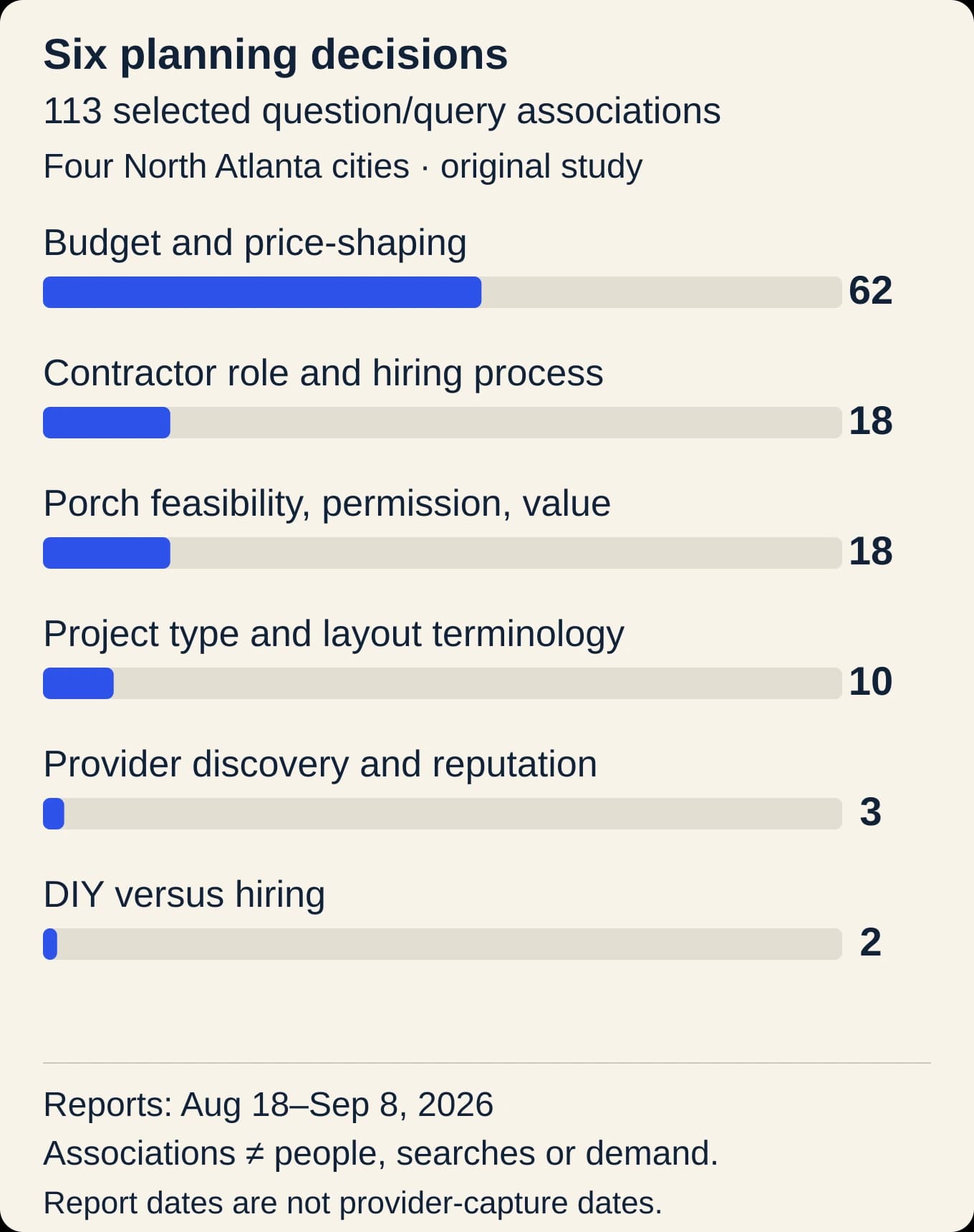
Planning decisions across the 113 selected question/query associations
| Planning decision | Question/query associations |
|---|---|
Budget and price-shaping | 62 |
General-contractor role and hiring process | 18 |
Porch feasibility, permission, and value | 18 |
Project-type and layout terminology | 10 |
Provider discovery and reputation | 3 |
DIY versus hiring | 2 |
Complete selected sample of 113 question/query associations. Associations are retained links between questions and query contexts, not searches, people, independent demand events, or search volume.
Separate budget, feasibility, role, and terminology pathways
Selected recurring wording illustrates why a single generic deck-or-porch page may leave different decisions unresolved. One deck-pricing question appeared in seven retained query/location associations, while a porch-feasibility question appeared in five. A general-contractor role question appeared in four associations, and a porch-versus-patio terminology question appeared in three.
The useful owner response is to make each page's decision purpose explicit. Budget content should disclose the inputs required for a property-specific estimate without inventing a local average. Feasibility content should identify what must be independently checked. Contractor-role and terminology content should define the business's actual scope rather than imply universal definitions.
Selected recurring question texts across retained query/location associations
| Planning decision | Selected normalized question | Retained associations and contexts | Useful owner implication |
|---|---|---|---|
Budget framing | How much should I pay someone to build a deck? | 7 associations: deck-building-company contexts in all four cities and affordable-deck-builder contexts in Marietta, Roswell, and Sandy Springs. | Explain estimate inputs and scope boundaries; do not publish an unsupported local price. |
Porch feasibility | Can you add a porch to an existing house? | 5 associations: adding-a-porch contexts in all four cities plus a cost-of-adding-a-porch context in Roswell. | Explain which structural, property, and permission questions require project-specific verification. |
Contractor role | Is a building contractor the same as a general contractor? | 4 associations: one general-building-contractor context in each city. | State the business's actual role and responsibilities instead of asserting a universal label. |
Project terminology | What is a porch vs. patio? | 3 associations: porch contexts in Alpharetta, Roswell, and Sandy Springs. | Define the project types the business describes or offers, with scope limits made explicit. |
This is a selected recurrence comparison, not the complete 113-association distribution. Counts are question/query associations, not searches, people, or demand volume.
Plan for different discovery surfaces
For one retained central coordinate in each city, the sampled Maps surface returned no places for the adding-a-porch query, while the corresponding organic result captured 15 slots in Roswell and 16 in each of Alpharetta, Marietta, and Sandy Springs.
This does not show that providers were absent, that organic results were better, or that wording caused the difference. It does show that an owner should not assume one discovery surface represents the whole path. Informational planning material can help explain the project, but any current service, coverage, or availability statement still requires direct verification.
Adding-a-porch result surfaces at one retained coordinate per city
| City and query | Sampled Maps places | Organic slots | Interpretation |
|---|---|---|---|
Roswell — adding a porch | 0 | 15 | The sampled surfaces differed; zero Maps places does not establish zero providers. |
Alpharetta — adding a porch to a house | 0 | 16 | Organic pages were present despite an empty sampled Maps result. |
Marietta — adding a porch to a house | 0 | 16 | The comparison describes two different result surfaces, not provider supply. |
Sandy Springs — adding a porch to a house | 0 | 16 | A later capture or another coordinate could produce a different result. |
All eight observations were retained in the September 8, 2026 report. Maps used one central coordinate per city. Maps places and organic slots are different units and are not a controlled ranking comparison.
Keep the market-position claim bounded
Other retained samples showed mixed result composition: broad deck queries included informational, retail, media, and unrelated material; local builder and contractor queries included contractor, service-area, and directory material; and porch-near-me Maps results included non-construction entities.
That evidence supports clearer project and role descriptions, but not claims that a wording change will improve rank, leads, or sales. Search position, categories, ratings, and review counts do not prove service quality, suitability, popularity, or causal marketing impact.
Questions
Frequently asked
What does 113 question/query associations mean?
Which planning decision had the most questions?
Does this study give a local price for building a deck or porch?
Does the study say whether a porch can be added to a house?
Did Maps show no providers for adding a porch?
How many organic slots were captured for the same query?
Will rewording my pages improve rank, leads, or sales?
How current is the evidence?
Keep reading
Related
8 sources · show· hide
- Deck-builder question association — Alpharetta
- Affordable-deck-builder question association — Marietta
- Porch-feasibility question association — Marietta
- Porch-feasibility question association — Roswell
- Porch-cost query question association — Roswell
- Contractor-role question association — Marietta
- Porch-terminology question association — Roswell
- Adding-a-porch Maps observation — Roswell, Alpharetta, Marietta, and Sandy Springs
Vendor pages change. Figures are as published on the capture date; confirm before deciding.