
Source review
The State of Local Search, 2026
Source-checked 2026 US local search statistics, two charts redrawn from BrightLocal findings, and the sample and limits behind each number.
A local-search statistic is useful only when its question, population and source are clear. This review checks three different kinds of evidence: BrightLocal's 2026 US consumer surveys about recent local searches and reviews; Google's own explanation of local ranking; and a practitioner survey about factors thought to matter in the Local Pack. They answer different questions and should not be combined into a single ranking formula.
BrightLocal's consumer-search series surveyed 1,227 US-based people who had searched online for a local business in the previous three months. Its figures describe those respondents' reported behavior, not all searches or all US adults. The headline 84% who had searched in three months comes from the broader screening population; the article does not disclose that denominator on the cited page. A separate 2026 BrightLocal review survey used 1,002 US adults.
This page is a source review, not a FlashCrafter consumer survey. It links to the study behind each key figure, flags a commonly misattributed weekly-search number, and separates Google's documented guidance from a survey of local-search practitioners. The findings are national survey results, not a measurement of any trade or city.
The evidence
Key findings
US consumers who searched for a local business in the previous three months
- Number
- 84%
- Basis
- BrightLocal Consumer Search Behavior 2026; share of its broader screened population. The cited article does not disclose that screening denominator.
Recent local searchers deciding which business to use in under 30 minutes
- Number
- 75%
- Basis
- BrightLocal Consumer Search Behavior: speed, June 2026; active US local-search panel (n=1,227).
Recent local searchers deciding in under five minutes
- Number
- 28%
- Basis
- BrightLocal Consumer Search Behavior: speed, June 2026; same active-search panel.
Recent local searchers who considered three or fewer businesses
- Number
- 72%
- Basis
- BrightLocal Consumer Search Behavior: speed, 24 June 2026; 1,227 US recent online local searchers. Question summarized: businesses considered before deciding, across channels; not the top three Google results. Source checked 25 October 2026.
Recent local searches started on a phone
- Number
- 73%
- Basis
- BrightLocal Consumer Search Behavior: channels, 2026; respondents describing their latest local-business search.
Recent local searches that used more than one channel
- Number
- 75%
- Basis
- BrightLocal Consumer Search Behavior: channels, 2026; respondents describing their latest local-business search.
Consumers who visited a business website after reading positive reviews
- Number
- 54%
- Basis
- BrightLocal Local Consumer Review Survey 2026; US adult panel (n=1,002). This is a reported next action after positive reviews, not a purchase rate.
| Option | Number | Basis |
|---|---|---|
| US consumers who searched for a local business in the previous three months | 84% | BrightLocal Consumer Search Behavior 2026; share of its broader screened population. The cited article does not disclose that screening denominator. |
| Recent local searchers deciding which business to use in under 30 minutes | 75% | BrightLocal Consumer Search Behavior: speed, June 2026; active US local-search panel (n=1,227). |
| Recent local searchers deciding in under five minutes | 28% | BrightLocal Consumer Search Behavior: speed, June 2026; same active-search panel. |
| Recent local searchers who considered three or fewer businesses | 72% | BrightLocal Consumer Search Behavior: speed, 24 June 2026; 1,227 US recent online local searchers. Question summarized: businesses considered before deciding, across channels; not the top three Google results. Source checked 25 October 2026. |
| Recent local searches started on a phone | 73% | BrightLocal Consumer Search Behavior: channels, 2026; respondents describing their latest local-business search. |
| Recent local searches that used more than one channel | 75% | BrightLocal Consumer Search Behavior: channels, 2026; respondents describing their latest local-business search. |
| Consumers who visited a business website after reading positive reviews | 54% | BrightLocal Local Consumer Review Survey 2026; US adult panel (n=1,002). This is a reported next action after positive reviews, not a purchase rate. |
Method
How the study was built
- 01
Read BrightLocal’s 2026 Consumer Search Behavior speed and channels reports and its 2026 Local Consumer Review Survey. Recorded each stated population, sample size, question and percentage without merging their denominators.
- 02
Checked Google Business Profile Help for its description of the main local ranking factors and the statement that businesses cannot request or pay for a better organic local ranking.
- 03
Traced the repeated 80% weekly-search claim to BrightLocal’s statistics compilation, which attributes it to the SOCi Consumer Behavior Index (2024), rather than to BrightLocal’s 2026 consumer-search survey.
- 04
Treated Whitespark’s ranking-factor percentages as practitioner opinion rather than measured Google algorithm weights. Excluded secondary claims when the underlying study or denominator could not be checked.
- 05
Redrew two charts from BrightLocal’s published 2026 percentages, keeping its question, US active-search sample (n=1,227), source URL and interpretation limit with each chart. These are FlashCrafter graphics of BrightLocal findings, not a FlashCrafter survey.
What it means
BrightLocal reports that 72% of active local searchers considered three or fewer businesses, yet this does not mean they saw only the top three search results. Google says local ranking is mainly based on relevance, distance, and popularity (explained under “Prominence”); the survey did not measure ranking effects.
For owners
What to act on
Check the Business Profile and website for accurate service, location, hours and contact information so shoppers can assess the business during a short decision window. This is a practical inference from the consumer survey, not a measured ranking lift. Expect discovery to involve more than one channel: BrightLocal found 75% used multiple channels in their latest local-business search. Keep essential details consistent wherever the business is actually present. Use Google’s relevance, distance and popularity (explained under “Prominence”) guidance when assessing local visibility. Do not treat practitioner-survey percentages as Google’s algorithm or pay a vendor for a promised organic local rank. Make the website useful after a positive review: 54% of respondents in BrightLocal’s separate 2026 review survey said they visited a business website next. This reports a stated action, not a guaranteed booking.
For customers
What to notice
A short shortlist can miss a suitable business. BrightLocal’s 72% figure describes how many businesses respondents considered, not which search positions they viewed. Check that hours, services, location and contact details agree across the business’s profile and website before relying on a listing. Use reviews as one input. A review survey describes reported habits across its US panel; it cannot certify the quality of an individual business.
How to read the consumer percentages
The 84% figure describes whether a consumer had searched online for a local business in a three-month period. The speed, shortlist and channel questions concern people who had done so, and therefore use a narrower group. The source describes a representative panel of 1,227 US-based active local searchers; it does not publish the screening denominator alongside the 84% result. The review survey is a different 1,002-person US adult panel. These percentages should not be multiplied into a conversion funnel.
The surveys rely on people recalling and describing their searches. They do not observe Google rankings, clicks, calls, purchases, or causal effects of a Business Profile change. BrightLocal says its findings and graphics may be used with attribution; this page restates selected figures in its own table and credits the original author and URLs.
Citation method and limits: FlashCrafter synthesized published BrightLocal findings and redrew two charts; it did not conduct a consumer survey or analyze respondent-level data. Cite BrightLocal as the survey author and the linked speed or channels report for the relevant question; cite this page for the synthesis/redraw. Reports published 24 June and 9 July 2026, respectively; sources checked 25 October 2026. Publication and source-check dates are not survey fieldwork dates, which the cited pages do not disclose. The 72% shortlist result uses 1,227 recent US online local searchers; the separate 84% three-month online-search result has an undisclosed screening base. No new denominator or combined conversion rate is calculated.
Limitations
The consumer-search panels cover US respondents and self-reported behavior. A national result does not establish the pattern for a particular service, city, age group, or business.
Looking at three or fewer businesses does not mean looking only at the first three Google listings. BrightLocal explicitly says the chosen businesses need not be the top three shown by a channel.
The 84% screening result lacks a disclosed base count on the cited study page. The 1,227 active-search sample must not be used as its denominator.
Whitespark’s Local Pack factor shares are expert-survey estimates, not disclosed Google ranking weights. Google’s ranking documentation does not assign percentages.
A 2024 SOCi weekly-search percentage appears in BrightLocal’s statistics compilation, but no direct SOCi study was verified for this review. It is not included as a key finding.
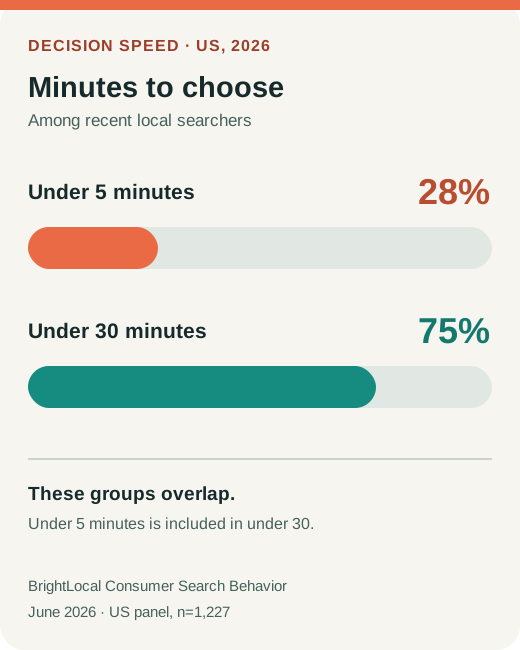
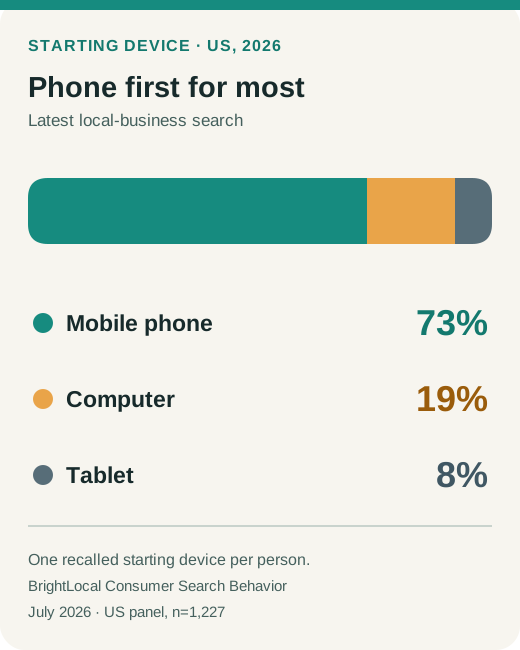
The original charts display selected BrightLocal results only. The decision-time bars overlap because under five minutes is included in under 30 minutes; the device categories answer a different question and must not be combined with decision time.
A short shortlist is not a top-three ranking study
BrightLocal asked consumers how many businesses they considered when choosing a local business. Its 72% figure is about the length of a shopper’s shortlist across discovery channels. The same series found that 75% decided in less than 30 minutes and that 75% used more than one channel during their latest search. Those are separate survey questions. Together they suggest that clear, consistent business information can help people assess options quickly; they do not show that any particular ranking position caused a choice.
For an owner, a practical check is whether a potential customer can see accurate services, location, hours, and contact options on the Business Profile and website. The survey cannot estimate the traffic gain from making those changes. The first graphic redraws BrightLocal’s two cumulative decision-time percentages, keeping the nested thresholds clear.
A separate question in the same panel found that 73% said their latest local-business search began on a phone, 19% on a computer and 8% on a tablet. The companion graphic shows that device split. It supports checking the actual phone experience; it does not prove a mobile ranking or conversion effect.
What Google documents about local ranking
Google says local results are mainly based on relevance, distance, and popularity (explained under “Prominence”). Relevance concerns how well a Business Profile matches a search; distance concerns proximity to the searcher; prominence concerns how well known the business is. Google also says there is no way to request or pay for a better local ranking. Those are platform statements, not percentages from a consumer survey.
Completing and updating a Business Profile can help Google understand a business, but the documentation does not promise a position. Whitespark’s annual ranking-factor survey asks practitioners to estimate the importance of signal groups. Its percentages may help generate hypotheses, but they are not Google’s algorithm weights and should not be presented as a precise allocation of ranking effort.
The weekly-search statistic needs its own attribution
BrightLocal’s statistics roundup says 80% of US consumers search online for local businesses weekly and 32% do so daily. Both figures are attributed there to the SOCi Consumer Behavior Index, 2024. They do not come from BrightLocal’s 2026 Consumer Search Behavior sample. We have not verified the underlying SOCi instrument or denominator, so neither number is used as a headline finding here.
This distinction matters because an editorial citation to this page should preserve the author and year of the underlying research. The 84% figure is BrightLocal’s 2026 three-month search result; it is not interchangeable with a weekly-search rate.
Comparisons
What each cited survey measured
| Source and sample | Question represented here | Reading limit |
|---|---|---|
BrightLocal Consumer Search Behavior 2026; 1,227 US-based active local searchers | Decision speed, shortlist length, device and channels used during a recent local-business search | Self-reported search behavior; does not measure ranking or purchase. The 84% screening result has a different, undisclosed base on the cited page. |
BrightLocal Local Consumer Review Survey 2026; 1,002 US adults via SurveyMonkey | Actions consumers say they take after reading positive reviews | Separate panel and question; 54% website visits cannot be merged with search-speed percentages. |
Google Business Profile Help; platform documentation | The main factors Google says determine local ranking | No factor percentages or promise of a position. |
SOCi Consumer Behavior Index 2024; cited by BrightLocal | Weekly and daily local-business-search frequency | Underlying study and denominator not verified here; excluded from key findings. |
Source review checked 25 October 2026. Original survey findings and graphics are credited to BrightLocal at the linked sources below. No FlashCrafter client or Briefs data contributed to this table.
Questions
Frequently asked
How many people search online for a local business?
Do 72% of customers choose from the top three Google results?
What are Google’s main local ranking factors?
Is the 80% weekly local-search figure from BrightLocal’s 2026 survey?
Is this original FlashCrafter consumer research?
Keep reading
Related
6 sources, captured 2026-10-25 · show· hide
- BrightLocal: Consumer Search Behavior 2026 — decision speed and shortlist
- BrightLocal: Consumer Search Behavior 2026 — channels and methodology
- BrightLocal: Local Consumer Review Survey 2026
- BrightLocal: Local SEO statistics (SOCi attribution)
- Google Business Profile Help: Tips to improve local ranking
- Whitespark: Local Search Ranking Factors (practitioner survey)
Vendor pages change. Figures are as published on the capture date; confirm before deciding.