
Guide
Tree Service SEO: Get Found in Maps and Search
Start with an accurate Business Profile and useful pages for real services. Make contact easy, then measure visibility, inquiries and booked work separately.
For US tree-service owners.
Start here
- Check profile accuracy
- Describe real tree work
- Test phone/form handoff
- Track web, Maps, inquiries and booked jobs
Core research captured Guide revised
Tree service SEO starts with an eligible, accurate Google Business Profile and pages that answer the questions people ask before hiring a crew. Explain the removal, pruning, stump, or emergency work you actually provide; show relevant local examples when you have them; and make the next contact step easy to find. Google says local results depend mainly on relevance, distance, and prominence. Adding a town to your profile does not guarantee a Maps position.
Check one service page before buying more SEO
Editorial worksheet, not measured evidence. Copy these blanks into your notes and review them with the person doing the work. Leave a check open until someone verifies it.
Fictional editorial example: stump grinding. This is a proposed worksheet row, not a client job or result. No photo, contact test or account ownership has been verified.
- 1. Page and job scope
- Proposed URL:
/services/stump-grinding. Confirm access, grindings removal and restoration scope with the owner.
Your URL: __________
Scope to confirm: __________
Service-page checks - 2. Photos and rights
- No photo supplied. Request an owner-supplied job photo and confirm permission to publish it.
Your photo / rights: __________
Verifiable local evidence - 3. Contact and handoff
- Phone/form untested; who answers is unconfirmed. Make a test inquiry and confirm receipt.
Your phone / form test: __________
Who answers: __________
Contact and measurement checks - 4. Responsibility and control
- Assign a reviewer and verify that the business owner controls the domain, Business Profile and analytics.
Person responsible: __________
Verification date: __________
Domain / profile / analytics owner: __________
Profile checks · Evaluate the provider
Accept the page when: the owner confirms its scope and photo rights, the contact test reaches the named responder, and responsibility, date and account control are recorded. This checks a deliverable and its handoff; it sets no ranking target.
A public stump-grinding page: five decisions before a quote
What does a useful service page help a homeowner decide? Hamm’s Tree Service provides a concrete example. Its public stump-grinding page was observed through Browserbase on October 26, 2026 at 03:33 UTC. This walkthrough describes the company’s published explanations; it does not establish credentials, job quality or search performance.
Read Hamm’s public stump-grinding page
- 1. Planned useWhat replaces the stump?
- 2. DepthWhat scope fits that use?
- 3. AccessCan equipment reach it?
- 4. Buried linesWho identifies each line?
- 5. FinishWhat happens to chips and soil?
What the page answers — and what to confirm
- 1. Planned use → agree the method
- Observed: The company distinguishes grinding from root-ball excavation and connects the choice to lawn, planting or structural plans. Ask: Given the intended use of this exact spot, which method is included in the quote?
- 2. Depth → write down the scope
- Observed: Hamm’s describes 6–8 inches below grade for turf and deeper, wider work for planting; it says deep roots remain after grinding. Ask: What depth, width and accessible roots will this job cover? The published turf range is the company’s description, not a universal specification.
- 3. Access → confirm a workable route
- Observed: The page asks homeowners to measure the narrowest gate or path and discusses slopes, wet ground and alternative access. Ask: What minimum clear width does the selected machine need, and who handles fence access and lawn repairs? No definitive minimum gate width was found.
- 4. Buried lines → assign responsibilities
- Observed: The company says public utilities are located through North Carolina 811 before grinding and asks the homeowner to identify private lines such as irrigation. Ask: Who requests and confirms public marking, and how will private lines be identified before work starts? The page does not settle the arrangements for an individual property.
- 5. Finish → specify the handover
- Observed: Hamm’s offers choices for leaving, spreading or hauling chips, with topsoil backfill described for the haul-away option. Ask: Which chip handling, soil, grading and restoration tasks are included, and at what final price? Published options do not establish a signed quote’s inclusions.
The page also shows click-to-call and quote links. Neither was activated in this observation. Hamm’s claims insurance, owner operation and more than 30 years of experience; those claims were not independently verified, and no ISA certification identifier was found. This public-page example implies no FlashCrafter client relationship or ranking result.
Apply the pattern: Let each service page answer the decisions customers face, then make unresolved scope and responsibility questions easy to raise when requesting a quote. Keep your own claims specific and supported.
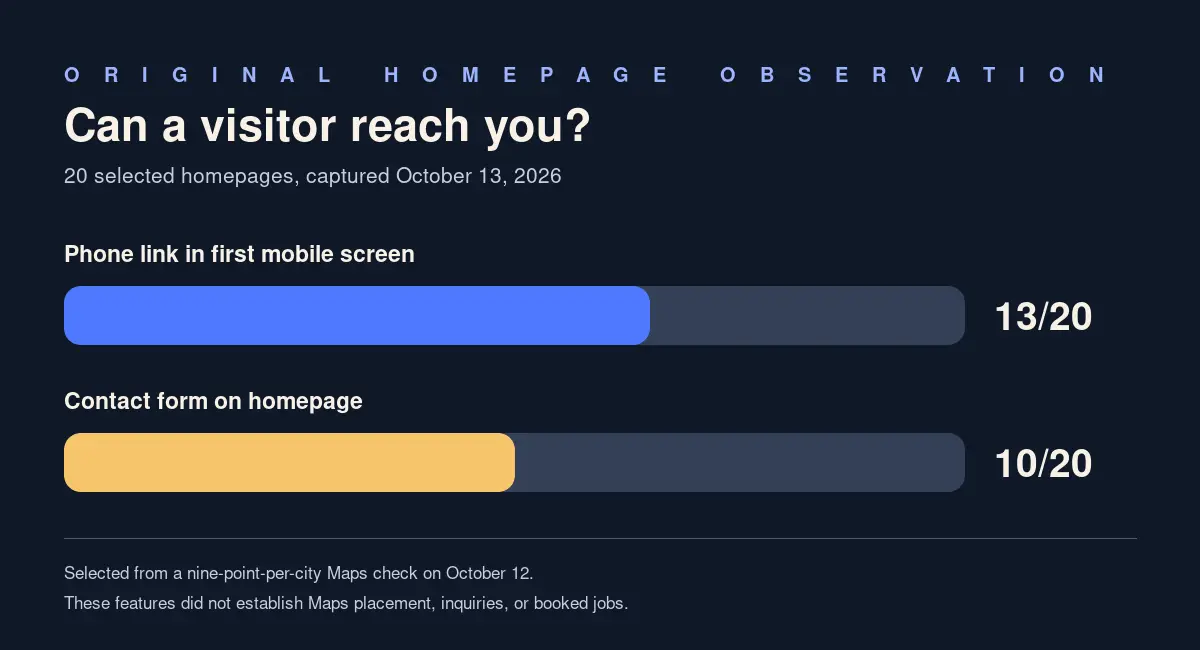
Use the worksheet above first, then the detailed sections and sourced price comparisons. Check website search traffic, map visibility, inquiries, and booked jobs separately. Measured evidence, with sample limits. Our 20 public website examples were selected from a nine-point-per-city Maps check on October 12, 2026 and captured October 13. They are examples to inspect, not evidence that a design caused ranking or leads. Price tables retain their individual source dates; Muon's official pages were rechecked October 26, 2026.
How Google Maps and website rankings fit together
A tree-service company can be visible through local map results and through website pages in search. These require separate measurement. Search Console reports website impressions, clicks, click-through rate, and average position; it is not a geographic map-ranking audit. Likewise, a quick phone or incognito search does not describe visibility across an entire service territory.
Google says local results depend mainly on relevance, distance, and prominence. Complete information helps it understand how closely a business matches a search. Links, review count, and positive ratings contribute to prominence. Google does not publish the factors’ weights, and it says there is no way to request or pay for better local rankings.
That makes accuracy and usefulness practical priorities. Describe the work your crew performs, maintain a legitimate profile, and publish information that helps customers judge the service. Keep expectations tied to the territory you can serve. A broader list of towns does not remove distance from the ranking system.
Google’s published local guidance gives no minimum review count, required star rating, posting frequency, photo quota, or guaranteed timetable for reaching the map pack. Evaluate a proposal by the work it includes and how progress will be measured. A promised position needs more scrutiny than a clear description of the tasks and reporting.
Set up a Business Profile that matches your operation
A business that travels to customers can qualify for a Google Business Profile. A service-area business should hide its address. Separate profiles require genuine separate locations with separate staff and service areas; virtual mailing offices are ineligible. Creating more listings is therefore a question of actual business eligibility, rather than a way to claim extra territory.
Use the real-world business name. Google says unnecessary service or location keywords in the name can cause suspension. Choose the fewest categories needed to describe the core business, as specifically as possible. These rules matter when reviewing your own listing or assessing profile changes proposed by an agency.
Google allows up to 20 service areas, entered as cities, postal codes, or other areas. You cannot specify a radius. Overall boundaries generally should stay within about two hours’ driving time, and edits can take up to 48 hours to appear. These are configuration rules, not a promised ranking radius.
Check whether that territory makes operational sense for your equipment and crew. The places listed on the profile should correspond to work you can actually accept. When evaluating map visibility, examine geographic differences rather than treating the saved service-area list as proof of coverage.
Business Profile rules to check
| Profile element | Google guidance | What it means for your business |
|---|---|---|
Business name | Use the real-world name; unnecessary keywords can cause suspension. | Keep service and city keyword lists out of the name. |
Categories | Use the fewest needed, as specifically as possible. | Describe the core business accurately. |
Address | A service-area business should hide its address. | Represent a business that travels to customers appropriately. |
Additional profiles | Require genuine separate locations, staff, and service areas. | Virtual mailing offices do not qualify. |
Territory | Up to 20 areas; generally within about two hours’ driving time; no radius setting. | Configuration does not guarantee rankings in each area. |
Service-area edits | Can take up to 48 hours to appear. | Allow for the published processing period when checking changes. |
Google Business Profile representation and service-area guidance, checked October 15, 2026.
Sources for this table
Choose keywords by the work customers need
Use the language customers use and organize pages around meaningful service differences. Someone seeking removal needs different information from someone comparing pruning or stump grinding. Emergency work also requires an accurate explanation of availability, contact method, territory, and response limitations.
SEO Brothers publishes the national estimates below, attributed to Ahrefs in May 2026. They are the publisher’s reported tool estimates, without an accessible underlying export in the examined passage. Use them as context for query wording, rather than as verified local demand figures. A national difficulty score does not establish competition in your city, and a difficulty of zero does not guarantee a ranking.
Start with services you actually provide. A keyword with substantial national volume is not a reason to advertise unavailable work. Relate the page choice to the service, equipment, and availability you can explain accurately, then use Search Console’s query and page filters to see which searches reach your website.
Published US national keyword estimates
| Query | Monthly searches | Ahrefs difficulty |
|---|---|---|
tree service near me | 55,000 | 33 |
tree removal near me | 39,000 | 34 |
arborist near me | 27,000 | 22 |
tree trimming near me | 25,000 | 10 |
stump grinding near me | 9,700 | 0 |
emergency tree removal | 7,200 | 0 |
SEO Brothers attributes these US national estimates to Ahrefs, May 2026. They are not independently verified primary Ahrefs data or city-specific forecasts.
Sources for this table
Build service pages that answer hiring questions
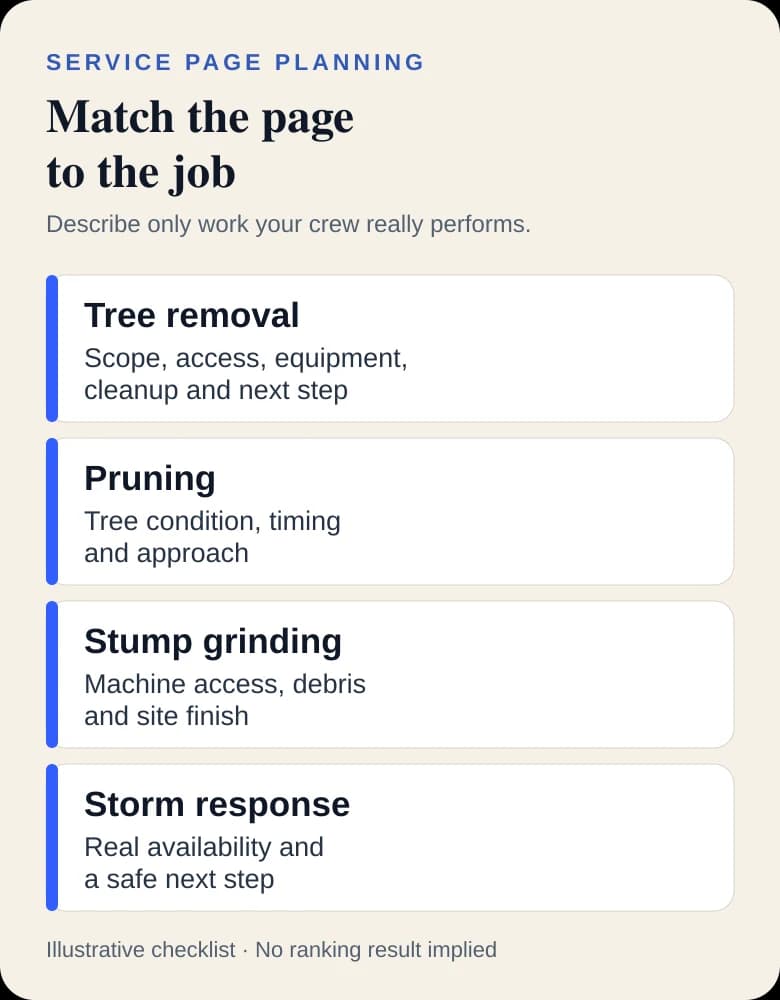
A useful service page explains what the job involves and what a customer needs to know before contacting you. For removal, that can include the process, access and equipment, price variables, cleanup, and local job evidence. For stump grinding, explain the grinding scope, access, handling of grindings, and restoration exclusions. Keep these explanations specific to the work you actually perform.
Google recommends useful, organized content, clear page titles, descriptive links, and the language readers use. It explicitly says there is no magical minimum or maximum word count. TRU SEO’s prescription of at least 1,500 words and Skill Mammoth’s 800–1,500-word approach are agency recommendations, not Google requirements. Keyword stuffing violates Google’s policies.
The page map below is a practical way to separate customer questions. It reflects the service and intent distinctions discussed by Four Arrows and Muon, together with Google’s guidance on useful pages. It is not a mandated site structure, and it does not establish a universal page count.
Keep emergency information accurate. Skill Mammoth discusses a permanent storm page, but its approximate two-thirds planned versus one-third emergency split and 48-hour storm-spike claim lack a supporting study in the relevant text. Those figures should not determine staffing or marketing forecasts. Explain the emergency service you can actually deliver instead.
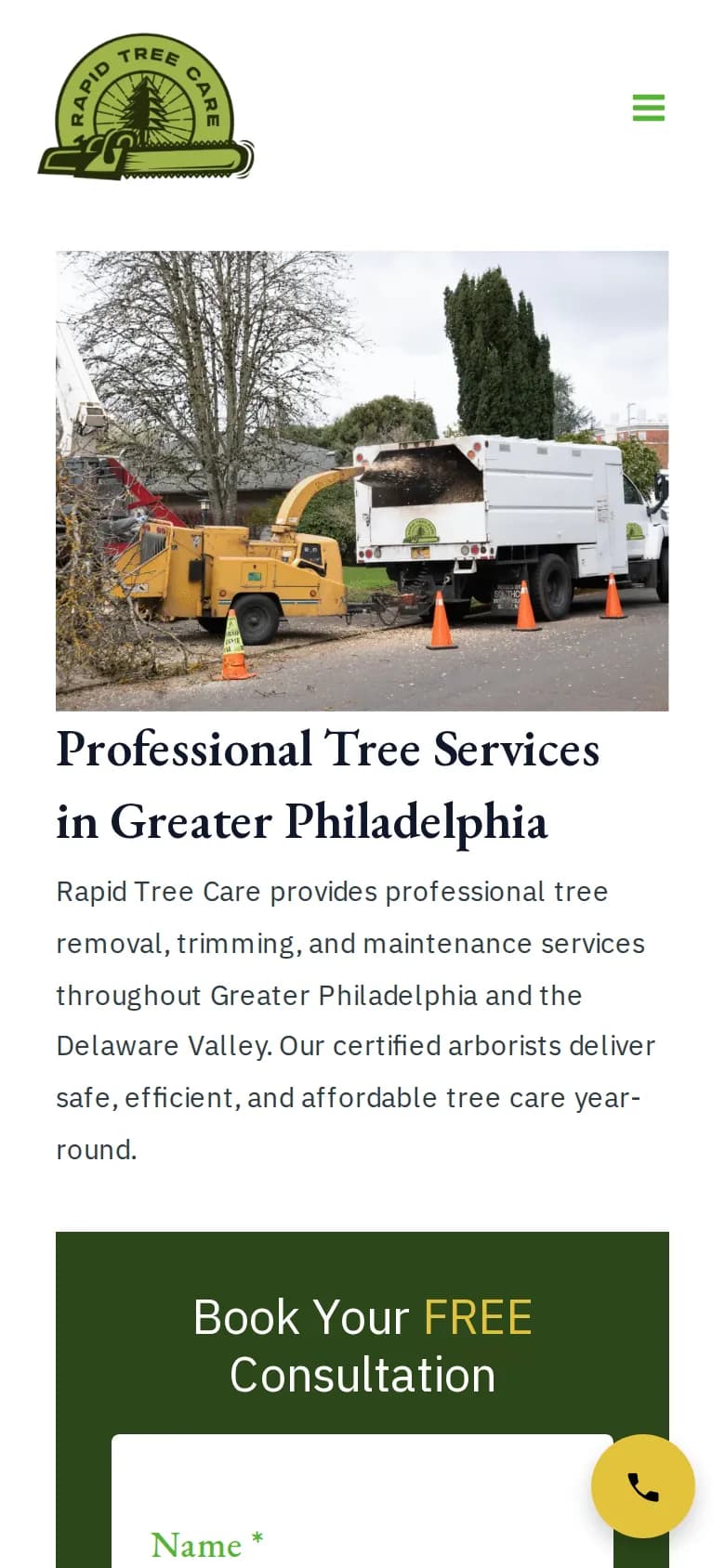
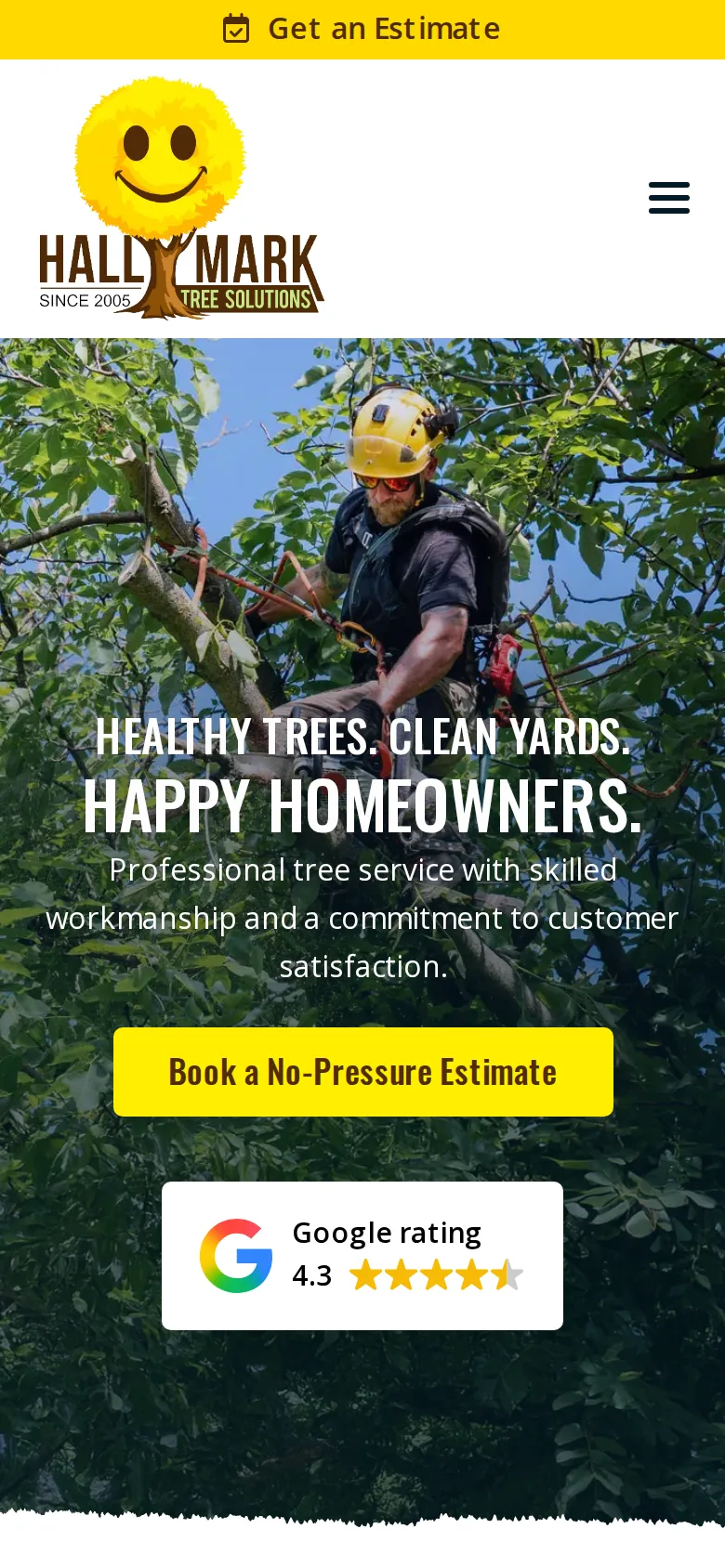
In FlashCrafter’s October 12, 2026 nine-point-per-city Google Maps check, 20 selected tree-service company homepages from 20 US cities were captured on October 13. 13 of 20 had a phone link in the first mobile screen, and 10 of 20 had a contact form. The gallery under Related shows examples of service explanations, credentials, and contact routes you can inspect. This selected Maps-visible sample does not show whether any website feature caused Maps placement, inquiries, or booked jobs.
Search intent and useful page content
| Search intent | Corresponding page subject |
|---|---|
tree removal [city] | Removal process, access/equipment, price variables, cleanup, local job evidence |
tree trimming/pruning [city] | Actual pruning services, appropriate work, local examples |
stump grinding [city] | Grinding scope, access, grindings, restoration exclusions |
emergency tree removal [city] | Actual availability, contact method, service territory, response limitations |
tree removal permit [city] | Municipality-specific rules and links to official applications |
certified arborist [city] | Named credential holder and a verifiable credential link |
Practical page mapping informed by the cited tree-service pages and Google's SEO Starter Guide.
Sources for this table
Make city pages and credentials verifiable
A city page can help when it contains information that matters to customers in that place. Google does not prohibit city pages as a category. Its spam policies identify substantially similar pages and regional or city pages that funnel visitors to one destination as examples of doorway abuse. Purpose and usefulness matter more than the city name in the title.
Give local pages an actual local purpose: accurate service coverage, real job examples, and relevant municipality-specific rules with official links. Do not turn one city’s requirements into national advice. Seattle, for example, publishes a registered tree-service-provider directory with registration numbers and website links. It states that street-tree work requires the relevant permit and that only providers with current TRAQ may prepare the specified hazardous-tree risk assessments. Those are Seattle requirements.
For credential searches, identify the credential holder and provide a way to verify the claim. ISA’s TreesAreGood directory supports finding and verifying credential holders. Participation in its listing is voluntary, so absence from the directory alone does not prove that someone lacks a credential.
LocalBusiness structured data can communicate business details to Google, but it does not guarantee a particular search appearance. Review rich results for local businesses are intended for sites reviewing other businesses. Marking up your company’s own testimonials does not make those testimonials eligible for that review-star appearance.
Ask for honest reviews and understand what the figures mean
Google allows review requests through a review link or QR code. Reviewers need a Google Account, which can use a non-Gmail email address. Google also encourages helpful replies. A neutral request gives customers a direct route to share their experience without dictating what they should say.
Google prohibits incentives, selectively soliciting positive reviews, discouraging negative reviews, and requests for specific review content. Its current policy also prohibits pressuring users to review on the premises. Check the actual request message and process, including any agency-managed system, against those restrictions.
BrightLocal’s Local Consumer Review Survey, published February 11, 2026, surveyed 1,002 US adults through SurveyMonkey. The findings below describe local businesses generally. They do not establish tree-service conversion rates or Google ranking thresholds. For example, a consumer preference for recent reviews does not prove that Google gives fresh reviews a particular measured ranking weight.
The survey’s 97% finding concerns reading local-business reviews. It should not be restated as 97% going online to find local services. Those are different claims. Similarly, the 54% who would visit a website after positive reviews expresses reported intention across local-business categories, rather than a forecast of tree-service bookings.
BrightLocal 2026 local review findings
| Measure | Published result | How to interpret it |
|---|---|---|
Read local-business reviews | 97% | General local-business review behavior. |
Always read reviews | 41%, versus 29% in 2025 | Reported frequency among surveyed US adults. |
Would not use a business with fewer than 20 reviews | 47% | Consumer preference, not a Google minimum. |
Only care about reviews from the last three months | 74% | Consumer preference, not an algorithm weighting. |
Require 4.5+ stars | 31% | Consumer preference, not a map-pack requirement. |
Use Google for reviews | 71%, versus 83% in 2025 | Reported review-platform use. |
Would visit a website after positive reviews | 54% | Reported intention, not a tree-service conversion rate. |
BrightLocal, February 11, 2026; 1,002 US adults surveyed through SurveyMonkey.
Sources for this table
Measure visibility, inquiries, and booked jobs separately
Google Business Profile’s Calls metric counts call-button clicks. It does not establish answered calls, qualified leads, or booked jobs. Its performance data can include both organic results and Google Ads, which also matters when assigning results to a marketing channel.
Search Console reports website impressions, clicks, CTR, and average position, with query and page filtering. Use it to understand which website pages attract searches. Keep those metrics separate from geographic map scans and from customer records. A report should make it clear whether a number describes visibility, an interaction, an actual conversation, or completed sales activity.
A phone or incognito spot check can show the result encountered in that check, but it is not a complete geographic ranking measurement. Rathly illustrates geographic grid reporting and labels its grid an example. That illustration is not a named client’s independently verified result and does not establish a guaranteed ranking radius.
Historical nearby-search statistics also need their dates and definitions. Google reported in 2016 that 76% of people searching nearby on a smartphone visited a related business within a day and that 28% of those searches resulted in a purchase. Those broad historical figures are not current tree-service lead-to-sale benchmarks. There is no representative US tree-service-specific map-pack click share, SEO conversion rate, average SEO return, or cost-per-booked-job benchmark established here.
Keep reporting definitions clear
| Measure | What it establishes | What it does not establish |
|---|---|---|
GBP Calls | Call-button clicks | Answered calls, qualified leads, or booked jobs |
Search Console | Website impressions, clicks, CTR, and average position | Complete geographic map visibility or booked work |
Geographic map checks | Visibility at the checked locations | A guaranteed service or ranking radius |
Business job records | Recorded inquiries, qualifications, and bookings | A substitute for measuring search visibility |
Metric definitions from Google's Business Profile and Search Console documentation. Rathly provides a geographic reporting example, not independent validation or an observed tree-service result.
Original data · measurement example
What to ask for in a local-ranking report
Ask for the exact query, map area, several sampling points and missing-result handling before treating one map position as service-area coverage.
This selected cross-trade Maps sample came from other service markets. It contains no tree-service observations and is not a tree-service ranking benchmark.
Read the selected five-point Google Maps studyA complete first-place result at every point
98 of 126 groups
28 groups lacked a complete first-place result and were excluded from the comparison.
Within the 98 complete groups
91 had a different first-place listing across the 5 points
7 retained the same first-place listing at all 5 points.
These nonrandom, nested area × query groups are correlated observations. They do not establish temporal volatility, organic rankings, leads, booked jobs or an SEO outcome.
One selected report supplies 52 of the 98 eligible groups; this sample should not be read as a national prevalence estimate.
How we selected and counted the sample
FlashCrafter Briefs admitted public-market findings. 7 selected reports were generated Aug 19, 2026–Sep 21, 2026; the stored projections were retrieved Oct 25, 2026. Underlying provider capture dates are unavailable and may be earlier.
Unit: one area × exact query group. Each area × exact-query group had five distinct sampling coordinates. Eligibility additionally required an identified first-place listing at every point.
Changed first-place groups / eligible groups by anonymous report:
- Report 1: 11/11
- Report 2: 5/6
- Report 3: 46/52
- Report 4: 7/7
- Report 5: 2/2
- Report 6: 5/5
- Report 7: 15/15
These report rows are parts of the same selected sample; they are not independent corroborations.
Compare published SEO prices without treating them as an industry average
Published SEO prices cover materially different services. Ahrefs’ provider survey offers broad context; individual vendor pages show advertised offers. Neither establishes a US tree-service industry average. Compare the actual page work, profile support, tracking, cancellation terms, and additional charges before deciding what a monthly price represents.
Ahrefs surveyed 439 SEO providers globally, and its article was updated August 15, 2024. It reports general SEO pricing of $250–$10,000/month, with 63% between $500 and $5,000. Its local SEO average is $1,557/month, including $1,819 for agencies and approximately $1,150 for freelancers. Some averages are calculated using pricing-band upper bounds rather than exact invoices.
For combined US/Canada respondents, 79.1% charge at least $1,001/month and 66.7% charge $75–$200/hour. Those regional figures combine both countries and should not be presented as a US tree-service sample.
Muon’s tree-service landing page and general pricing page publish different offers. The tree-service page says its performance and flat options have identical scope, but that does not establish identical deliverables across all general packages. Its current general pricing page lists ten local SEO blog posts per month in The Foundation. The qualified-lead rate in the separate tree-service Performance offer is not published as a number; confirm that rate, scope and total price in writing before comparing offers.
Google says appearing in organic search costs nothing and purchasing Google advertising does not affect organic presence. Fees paid to an agency or software provider purchase their services. Google warns against first-place guarantees and notes that third-party SEO tools do not have access to its internal ranking data.
Agency and provider pricing
| Source or offer | Published price | Scope and limits |
|---|---|---|
Ahrefs general SEO survey | $250–$10,000/month; 63% at $500–$5,000/month | 439 global SEO providers; updated August 15, 2024. |
Ahrefs local SEO averages | $1,557/month overall; agencies $1,819; freelancers approximately $1,150 | Global provider context; some calculations use band upper bounds. |
Ahrefs US/Canada figures | 79.1% at least $1,001/month; 66.7% at $75–$200/hour | Combined US and Canada respondents. |
Rathly tree-service SEO | From $2,000/month | Month-to-month, cancel anytime; map work, removal/trimming/stump pages, job-type tracking; fixed page/keyword allowances unpublished. |
Muon tree-service Performance | From $195/month plus an agreed price per qualified lead | No setup fee; month-to-month; numeric lead price unpublished. |
Muon tree-service Flat | From $395/month | No per-lead charge; no setup fee; month-to-month; says scope matches Performance. |
Muon general Tech Partner | $299/month | Current general pricing page: website and AI care, technical SEO, and one new page per month. |
Muon general The Foundation | $950/month | Current general pricing page: includes Tech Partner and ten local SEO blog posts per month. |
Muon general Custom | By quote | Current general pricing page names custom scope for multiple locations, landing pages and competitive markets; no fixed price displayed. |
USD. Muon official pages rechecked October 26, 2026; Ahrefs and Rathly figures retain their October 15 checks.
Compare website-and-marketing subscriptions by their limits
Tree Web Design combines website services and marketing in its subscriptions. That makes its prices useful to compare within the published plan structure, while keeping them separate from agency retainers with different deliverables. Its launch-page counts and ongoing page allowances provide concrete limits to examine.
The vendor states that there are no setup fees and that hosting and SSL are included. Advertising spend and Local Services Ads budgets are paid separately to Google. The Pro subscription’s campaign allowance therefore does not mean the listed monthly fee includes advertising media spend.
Check both the commitment and the type of ongoing support. Lite is month-to-month with no contract, while Growth and Pro have 12-month terms. Profile setup or an audit, monthly profile support, and weekly profile support are different published deliverables; compare the one your operation needs with the pages included at launch and afterward.
Tree Web Design subscriptions
| Plan | Exact price and term | Published scope |
|---|---|---|
Lite — Professional Presence | $150/month; month-to-month, no contract | 5 launch pages; Business Profile setup/audit |
Growth — Local SEO Foundation | $350/month; 12-month term | 5 core + 3 service/city pages at launch; 1 additional page/month; monthly profile support |
Pro — Local SEO + Ads | $750/month; 12-month term | 5 core + 5 service/city pages at launch; 2 additional pages/month; weekly profile support; up to 3 focused search campaigns |
No setup fees; hosting and SSL included. Advertising spend and Local Services Ads budgets are separate. USD, checked October 15, 2026.
Sources for this table
Budget for tracking software using the current vendor prices
BrightLocal provides a published example of software costs for local rank tracking, listings, and reviews. Its current one-location pricing table takes precedence over lower figures appearing on G2 and in the Help Center’s opening copy. Compare the actual capabilities and billing commitment, rather than assuming every plan includes review requests or listing synchronization.
The annual monthly equivalents below are the vendor’s rounded display figures; the annual invoice totals are shown separately. Citation Builder is a separate pay-as-you-go service. Software access also remains distinct from paying someone to perform the underlying profile, website, or review-management work.
G2’s pricing page, last updated May 13, 2026, lists Track at $39/month, Manage at $49, Grow at $59, and Enterprise as Contact Us. Those figures differ from the current vendor table. BrightLocal’s Help Center opening copy also says prices start at $39/month, although its tables show $41/$54/$65. Use the vendor table below for budgeting.
G2’s BrightLocal seller profile showed 4.6/5 from 230 reviews on October 15, 2026. That is a software satisfaction rating. It does not show that buying the software produces rankings or establishes a return for a tree-service company.
BrightLocal one-location plans
| Plan | Monthly billing | Annual billing | Published distinction |
|---|---|---|---|
Track | $41/month | $369/year; displayed as $31/month | Up to 100 keywords, 4 competitors, geo-grid tracking for up to 5 keywords |
Manage | $54/month | $485/year; displayed as $40/month | Track plus listing synchronization and Business Profile post scheduling |
Grow | $65/month | $584/year; displayed as $49/month | Manage plus review monitoring/responding, requests, and website review display |
Vendor prices, USD, checked October 15, 2026. Annual monthly equivalents are rounded display figures. Citation Builder is separate.
Sources for this table
Assess SEO advice by its evidence and definitions
The pages returned early for the exact-query search cover many practical subjects, especially keywords, Business Profiles, service pages, and reviews. Their appearance describes that search tool’s returned results, rather than verified location-specific Google rankings. The comparison below assesses their content; it does not assign fixed nationwide positions.
Distinguish useful recommendations from measured claims. An agency can recommend a page length or describe an expected timeline without establishing a Google requirement or a typical tree-service outcome. Likewise, an illustrated grid, national keyword estimate, or consumer survey answers a different question from a verified booked-job result.
Across these pages, guidance is less detailed on service-area eligibility, review-request restrictions, methodology, and the difference between call-button clicks and completed jobs. Keep those questions in a provider discussion. Google does not publish a universal number of pages, words, reviews, backlinks, months, or dollars that makes a tree-service business rank.
Tree-service SEO page comparison
| Page and visible date | Coverage | Claims or limits to examine |
|---|---|---|
TRU SEO Solutions; opened copy references 2025 | Keywords, titles, service/city pages, GBP, citations, speed, schema, backlinks, reporting | At least 1,500 words is not a Google requirement. Search Console website metrics differ from geographic map rankings. Search-snippet plan prices were not reproduced on the opened page and remain unconfirmed. |
Skill Mammoth; August 17, 2026 | Planned versus emergency demand, dedicated pages, equipment-limited territory, permanent storm page | Approximate two-thirds planned/one-third emergency demand and 48-hour storm spikes lack a supporting study in the relevant text. Its 800–1,500 words is an agency approach. |
Tree Revenue; August 1, 2026 | Maps versus organic results, three local factors, services, reviews, local pages | Fresh-review weighting claim lacks a measured weighting study. Phone/incognito spot checks do not provide complete geographic measurement. |
Four Arrows Marketing; January 30, 2026 | Transactional, informational, seasonal keywords; removal, pruning, stump, emergency, health, clearing pages | Its 97% online-service-finding wording lacks an adjacent primary study and differs from BrightLocal’s 97% review-reading finding. |
SEO Brothers | Keyword tables, architecture, seasonal content, GBP, storm work | National estimates attributed to Ahrefs, May 2026; underlying export unavailable in the examined passage. National difficulty does not establish city competition. |
Muon Marketing | Cost and permit content, credentials, emergency/planned pages, booked-job measurement, costs | Two-month impression and months-three-to-six booked-work expectations lack a published cohort/methodology. Numeric per-lead price is undisclosed. |
Rathly | Maps, job-specific pages, geographic grid, seasonal searches, pricing | Grid is labeled an example, not an independently verified named-client result. No guaranteed ranking radius is published. |
Content checked October 15, 2026. The pages reviewed are linked below.
Research context
Facts to keep in view
What Google names for local results: Relevance, distance, prominence
Google names these three main factors but does not publish their weights. Accurate business information and useful pages help people and Google understand what you do.
Our selected mobile-homepage sample: 13 of 20 showed a phone link
FlashCrafter captured one selected Maps-visible tree-service homepage per city on October 13, 2026. This counts visible first-screen contact paths, not leads or ranking causes.
A practical path
What to do
- 01
Check Business Profile eligibility, real business name, main category and actual service areas against Google’s rules. A listed city does not create a ranking radius.
- 02
Create useful pages for the removal, pruning, stump or emergency work your crew actually performs. Explain scope, access, cleanup, availability and how to contact you.
- 03
Test the phone link or request form on a phone. Track Search Console clicks, Maps visibility, qualified inquiries and booked work separately with dated baselines.
Watch for these
Common mistakes
Treating service areas as a ranking radius
A town in your profile describes territory. It does not guarantee placement there; assess visibility across the places you can actually serve.
Calling clicks completed work
Report website clicks, calls and requests, qualified inquiries, and booked jobs as different measures; verify the handoff to the person who responds.
Takeaway
Tree service SEO depends on an accurate Business Profile, useful service pages, honest reviews, and local relevance. Match the work to your real territory, compare costs by deliverables, and measure booked jobs separately from clicks.
Start with eligibility
Google Business Profile
Use the real business name, suitable categories, and an accurate service area. Hide a service-area business’s address and use additional profiles only for genuinely separate eligible locations.
Build useful pages
Services and local evidence
Explain the jobs you perform, access requirements, cleanup, availability, and relevant local rules. Add credential verification where appropriate; choose useful detail over a fixed word quota.
Measure business results
Visibility plus job records
Compare Search Console and geographic map measurements with answered calls, qualified leads, and booked work. Profile call-button clicks alone do not establish customer acquisition.
Compare the actual offer
Deliverables, terms, and total fees
Separate software, website subscriptions, agency work, and advertising budgets. Check page allowances, contract length, reporting definitions, and any additional qualified-lead charge before choosing a provider.
Questions
Frequently asked
How does a tree-service company rank in Google Maps?
Can I rank in every city listed in my service area?
How many reviews and what rating do I need?
What is the right way to ask customers for Google reviews?
Which keywords and service pages should I prioritize?
How long should a tree-service page be?
How much does tree service SEO cost?
How quickly will SEO produce booked jobs?
How should I measure whether the work is paying off?
Can ads, structured data, or software guarantee rankings?
Keep reading
Related
- Tree Service marketing
- 20 Real Tree Service Websites
- Tree Service Website Cost
- Tree Service Get More Customers
- Tree Service Local SEO
- Accountants SEO Guide
33 sources, captured 2026-10-15 · show· hide
- Google: Improve your local ranking
- Google: Business representation guidelines
- Google: Manage service areas
- Google: Get more reviews
- Google Maps content policy
- Google SEO Starter Guide
- Google Search spam policies
- Google LocalBusiness structured data
- Google review snippets
- Google: Hiring an SEO
- BrightLocal Local Consumer Review Survey 2026
- Google 2016 holiday marketing guide
- Google nearby-search article, November 22, 2016
- Ahrefs SEO pricing survey
- Rathly tree-service SEO
- Muon tree-service offer
- Muon general pricing
- Tree Web Design pricing
- BrightLocal pricing
- G2 BrightLocal pricing
- BrightLocal Help Center pricing
- G2 BrightLocal seller profile
- TRU SEO Solutions tree-service guide
- Skill Mammoth tree-service SEO
- Tree Revenue tree-service SEO
- Four Arrows tree-service SEO
- SEO Brothers tree-service guide and keyword estimates
- Google Business Profile performance metrics
- Search Console performance documentation
- ISA TreesAreGood credential verification
- Seattle tree-service-provider directory
- FlashCrafter: 20 real tree-service websites and selection method (October 2026)
- Hamm’s Tree Service — public stump-grinding page, observed October 26, 2026; company claims not independently verified
Vendor pages change. Figures are as published on the capture date; confirm before deciding.